
Microbreweries are flourishing across regional New South Wales, driven by local tourism and demand for artisanal products. But approvals are not easy to obtain and must overcome planning restrictions and local resident objections.
Buckettys Brewery has overcome objections by local residents against Council approval for a food and drink premises comprising a pub, restaurant and ancillary brewery near Bucketty, (a locality not a village) in the Hunter Valley, near Cessnock.
Friends of Bucketty Incorporated, a community action group, were not happy with the approval. They did not want a pub and restaurant "in their backyard". They were concerned that the development would "alter the tone" of the locality of Bucketty. They were concerned that core koala habitat would be threatened. They applied to the Court to have the Development Consent granted by Council for the microbrewery component to be reviewed and declared invalid.
This article is based on the NSW Land and Environment Court decision of Friends of Bucketty Incorporated v Buckettys Brewery Pty Ltd [2026] NSWLEC 118,a decision of Justice Pritchard handed down on 11 September 2026.
The Council Approval
The land is in an RU2 Rural Landscape zone under the Cessnock LEP (Local Environmental Plan). The land is 27.57 acres (11.16 hectares) which is mostly forested, at 5439 George Downs Drive, Bucketty. The proposed development was to be on the cleared portion of the land which is approximately 4.5 acres. No trees were to be removed.
At the time, the zoning permitted the proposed use as food and drink premises, with Council consent.
The statement of environmental effects prepared for Buckettys Brewery for the development application contained this description:
“The use is uniquely located conveniently to cater to tourists along Tourist Drive 33 and affords visitors to the area an opportunity to appreciate the rural setting, to revive for their drive, and to learn of the small-scale Hop cultivation. Prohibiting the proposed use would significantly and artificially limit the use of otherwise constrained land for compatible rural purposes.”
|
The Council approval was for food and drink premises comprising the following: • A pub and ancillary brewery; • A restaurant/cafe; and • Associated car parking and on-site effluent disposal area. The Development Consent (the Council approval) was granted 19 March 2025. |
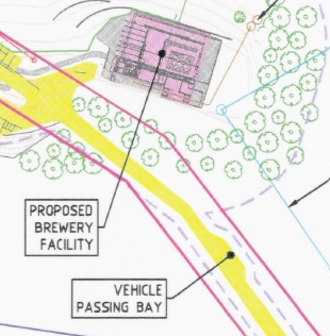 Plan of Buckettys Brewery premises |
The Council assessment report described the proposed development as follows:
“The brewery is ancillary to the pub component of the development and will essentially be a showcase feature located behind the bar area to expose customers to brewed beers (in limited quantities) on site, or beers brewed off-site at the owner's brewery located in Brookvale NSW. The hops required in the brewing process are currently grown on the site (it is noted that the growing of hops is a form of agriculture which is permitted without development consent).
The production capacity of the ancillary brewing facility will be a maximum of 1.5 kl (1,500 litres) of beer per month. The brewed beer will be available for tasting at the premises, and for takeaway consumption.
The premises will have a maximum capacity of 150 people …”
The on-premises liquor licence
NSW Police (the liquor licensing authority) did not support a hotel licence but did support an on-premises liquor licence (for the restaurant and bar) and a wholesaler/producer licence within the premises.
The licence issued by NSW Liquor & Gaming Authority has an operation plan of management as follows:
Service of Alcohol - We do support beer education and the enhanced enjoyment of our beer through the knowledge of how it was made and what ingredients go into making good beer. We regularly run tasting events to encourage responsible enjoyment of beer.
On site consumption of alcohol is only permitted with a meal from the on-site kitchen.
Complimentary tasters of beer are available at the bar without a meal. Tasters must not be more than 30ml and a maximum of 4 tasters are permitted per patron without ordering a meal.
Takeaway Sales - Takeaway sales are to be conducted within the designated wholesaler/producer licenced area adjacent to the bar. Available for sale will be beer and products brewed both on site, and other Buckettys licensed facilities.
Ancillary Brewing - A small brewing system will be installed within the premises, which will be used to develop small batch beers for consumption on site and take home consumption.
The Court proceedings
Friends of Bucketty applied to the NSW Land and Environment Court to challenge the validity of the Development Consent granted by the Cessnock City Council. Buckettys Brewery defended the Development Consent. The Council did not take an active role, which is normal in these kinds of Court proceedings.
The Court upheld the validity of the Development Consent. In reaching its decision, the Court considered these issues:
- Did Amendment 40, which prohibited food and drink premises in an R2 Landscape zoning, invalidate the approval?
The Court ruled that when the Buckettys Brewery application was lodged with the Council, Amendment 40 was a “proposed instrument” because it had not been made or come into force. Therefore, the Development Application had the benefit of the ‘savings provision’ as a lodgement already made, and the application was to be assessed as if Amendment 40 had not commenced. The food and drink premises was a permitted use at the date of lodgement and could be approved. - Did the application need to satisfy ‘integrated development’ requirements?
The court confirmed that if a proposed development is ‘integrated development’, then the Council must refer the Development Application to the relevant authority for approval. When it made the application, Buckettys Brewery thought it needed approval from NSW Rural Fire Service. Later on, WaterNSW was also raised as a relevant authority which must give approval.
The Court ruled on a technical basis that the development did not require the approval of WaterNSW under the Water Management Act because the development was not “waterfront land”, as it was not within 40 metres of a creek. Therefore, the development did not need to satisfy integrated development requirements as to approval from WaterNSW. - Was the proposed brewery an ancillary use for the land (which was permitted) as opposed to an independent and prohibited use (which was not permitted) under the zoning?
The Court ruled that the brewery was an ancillary use of the land. It was ancillary to the food and drink premises consisting of a restaurant component (operating with an on-premises licence) and a takeaway sales area (operating with a wholesaler/producer licence).
The Court gave these reasons:
“the brewing equipment is limited in its production capacity to only allowing tastings of less than a schooner per person per day, and that the area of the brewery component was only 48 square metres, whereas the restaurant seating areas, kitchen and back of house (not all of which would be used for the restaurant) totalled 360 square metres, that the proper characterisation of the micro-brewery is a use for a purpose ancillary to the restaurant.”
“As a matter of fact and degree in all the circumstances of the case, I consider the brewery component, properly characterised, is ancillary to the use of the land for the purpose of a food and drink premises consisting of a restaurant component (operating with an on-premises licence) and a takeaway sales area (operating with a wholesaler/producer licence).” - Did the Koala Habitat Protection Guideline apply?
Much of the land is a heavily vegetated forest, which contained koala habitat trees. It is adjacent to Yengo National Park. Council kept a ‘Koala sightings Map’. But was it core koala habitat?
There were no reports from “suitably qualified people making observations over a period of time as to whether or not there are mating, or female and nursing, koalas in that location”. “No Koalas were observed during the fauna survey and no evidence of Koala habitation, such as scats, claw and scratch marks, were located on the site”, and that while “transient individuals may occasionally use the site”, there was “no known local population of Koalas”.
The Court ruled that the Council was entitled to rely on the information before it that the land was not core koala habitat. Therefore, the Biodiversity SEPP (State Environmental Planning Policy) and Koala Habitat Protection Guideline did not apply.
The Court concluded that the Friends of Bucketty had failed to establish any of the grounds relied on in its challenge to the validity of Council’s decision to grant Development Consent. The Court dismissed the application. Therefore, the Development Consent was upheld.
The Legal Costs Dispute
The general rule is that the court orders that the legal costs follow the event (that is, the ‘loser’ pays the ‘winner’s’ legal costs) unless it appears to the court that some other order should be made as to the whole or any part of the costs (rule 42.1 of the Uniform Civil Procedure Rules 2005 (UCPR Rules)).
Buckettys Brewery incurred significant legal costs in successfully defending the application and sought an order that Friends of Bucketty pay its legal costs.
Friends of Bucketty sought to rely on rule 4.2(1) of the Land and Environment Court Rules 2007 (LEC Rules), which provides:
4.2 Proceedings brought in the public interest
(1) The Court may decide not to make an order for the payment of costs against an unsuccessful applicant in any proceedings if it is satisfied that the proceedings have been brought in the public interest.
Rule 4.2 LEC Rules will prevail over Rule 42.1 UCPR Rules.
The costs decision is Friends of Bucketty Incorporated v Buckettys Brewery Pty Ltd (No 2) [2026] NSWLEC 126 (2 October 2026).
Justice Pritchard made these findings on the key issue, which was whether the proceedings had been brought in the public interest:
- There is a much broader public interest in preserving the sensitive rural environment of the development site when contrasted against the private interests of a privately owned brewery;
- The Council misunderstood the savings provision of Amendment 40;
- The law on integrated developments was clarified in these proceedings;
- Council’s conclusion that the land was not core koala habitat was not legally unreasonable;
- None of the Friends of Bucketty had a pecuniary or material interest in the outcome of the proceedings.
Justice Pritchard concluded: “In all the circumstances, I am satisfied that the proceedings were brought in the public interest and that it is appropriate to exercise the discretion in r 4.2(1) of the LEC Rules not to make an order for the payment of costs by the applicant”.
He ordered: “Pursuant to r 4.2(1) of the LEC Rules, each party to pay their own costs of the proceedings.”
Comments
The approval process for the pub, brewery and restaurant began in April 2023. Three years later, Development Consent has been confirmed by the Land and Environment Court.
The family behind Buckettys Brewery has been patient, but also lucky. An amendment to the Cessnock planning rules now prohibits food and drink premises in rural areas zoned RU2 Rural Landscape. They have an approval for a microbrewery and restaurant which no neighbour can obtain.
The NSW Tourism Association and Destination NSW are being hamstrung in promoting regional tourism when Councils, such as the Cessnock Council in this case, change the planning rules to prohibit food and drink premises on rural land.
Agritourism has a well-developed policy framework: the Agritourism SEPP (State Environmental Planning Policy). But the Agritourism SEPP is restricted to commercial farms. In this case, the small-scale cultivation of hops for use in a microbrewery does not make the farm a commercial farm. The approval was because the use of the land as food and drink premises was permissible under the zoning, and the microbrewery was ancillary to that use.
A good illustration where a microbrewery was prohibited on rural zoned land is in the Baillie Wines case. The Camden Council prohibited a microbrewery because brewing beer was a light industrial use (which was prohibited), even though the beer was to be brewed from hops grown on the farm – see my article